


Why Government Strategic Communications Drives Policy Success
Government strategic communications is the practice of influencing audiences for public good by marshalling necessary resources in a coherent plan, underpinned by research, working to milestones, and properly evaluated. It’s far more than just broadcasting government work – it’s a vital lever to achieve policy objectives alongside legislation, regulation, taxation and public spending.
Here’s what makes government strategic communications effective:
- Audience-first approach – Understanding citizens’ needs, behaviors and barriers before crafting messages
- Evidence-based frameworks – Using proven models like OASIS, COM-B and EAST to structure campaigns
- Behavioral science integration – Applying psychology to make policies Easy, Attractive, Social and Timely
- Multi-channel coordination – Synchronizing messages across traditional media, digital platforms and direct engagement
- Continuous evaluation – Measuring outcomes, not just outputs, to improve future efforts
The stakes couldn’t be higher. Only around one-third of Americans trust the federal government, highlighting the urgent need for effective communication to rebuild that trust. Yet success stories abound – Singapore achieved 99% digital government services through strategic engagement, while the UK’s Brexit campaign reached 99% of adults with 52% taking action.
Modern government communications faces a 24/7 information environment where “it is impossible not to communicate; everything the joint force does sends a message.” This reality demands strategic thinking over tactical reactions.
The difference between strategic and tactical communications is simple: tactical responds to what happened yesterday, while strategic shapes what happens tomorrow. Strategic communications puts audience understanding at the heart of policy and service design, resulting in better decision-making and improved delivery.
Understanding Government Strategic Communications
Government strategic communications is the bridge between good policy and real-world impact. It’s not about spinning stories – it’s about creating genuine connections that help policies actually work in people’s lives.
The UK Government Communication Service defines strategic communications as understanding your audience so well that you can create conditions that support your goals. This goes beyond press releases or social media posts – it’s about changing how people think, feel, and act.
Research shows that 90% of our daily decisions come from gut feelings and emotions, not careful analysis of facts. This changes everything about how government should communicate. You can’t just throw data at people and expect them to change their behavior.
The trust triangle framework, popularised by research in Harvard Business Review – “Begin with Trust”, provides a roadmap for effective communication built on three pillars:
Authenticity means your messages match your values and follow the Civil Service Code. Logic involves taking complex information and making it clear with solid evidence. Empathy shows that you understand what keeps people up at night.
Strategic communications is proactive, while tactical communications is reactive. Most government communications falls into the tactical trap – something happens, so you respond. Strategic communications flips this around entirely.
Let’s say you’re launching a new health program. The tactical approach? Announce it and hope people sign up. The strategic approach? You spend months understanding why people avoid healthcare, what scares them, what motivates them. You craft different messages for different groups, coordinate across multiple channels, and measure whether people actually change their behavior.
Why It Matters for Modern Democracies
Government strategic communications isn’t just nice to have – it’s essential for democracy to function. Without it, even brilliant policies can fail because nobody understands or trusts them enough to participate.
Only about one-third of Americans trust the federal government. That’s not just a PR problem – it’s a governance crisis. When people don’t trust government, they don’t follow public health guidelines or participate in programs designed to help them.
When government gets strategic communications right, amazing things happen. The Veterans Affairs turned their reputation around completely. Through focused customer experience work and strategic communications, nearly 80% of VA customers now trust the agency – more than double the federal government average.
This trust translates into real results. Veterans are more likely to seek mental health care, use educational benefits, and participate in job training programs. Trust literally saves lives and improves outcomes.
Strategic communications serves four critical functions: it builds legitimacy through transparency, increases policy uptake by making complex information accessible, improves crisis resilience by building trust during normal times, and strengthens democratic participation by helping citizens make informed decisions.
Core Principles & Proven Frameworks
Government strategic communications relies on proven frameworks that take the guesswork out of strategic planning. Think of these as your communication toolkit – each designed for specific situations and challenges.
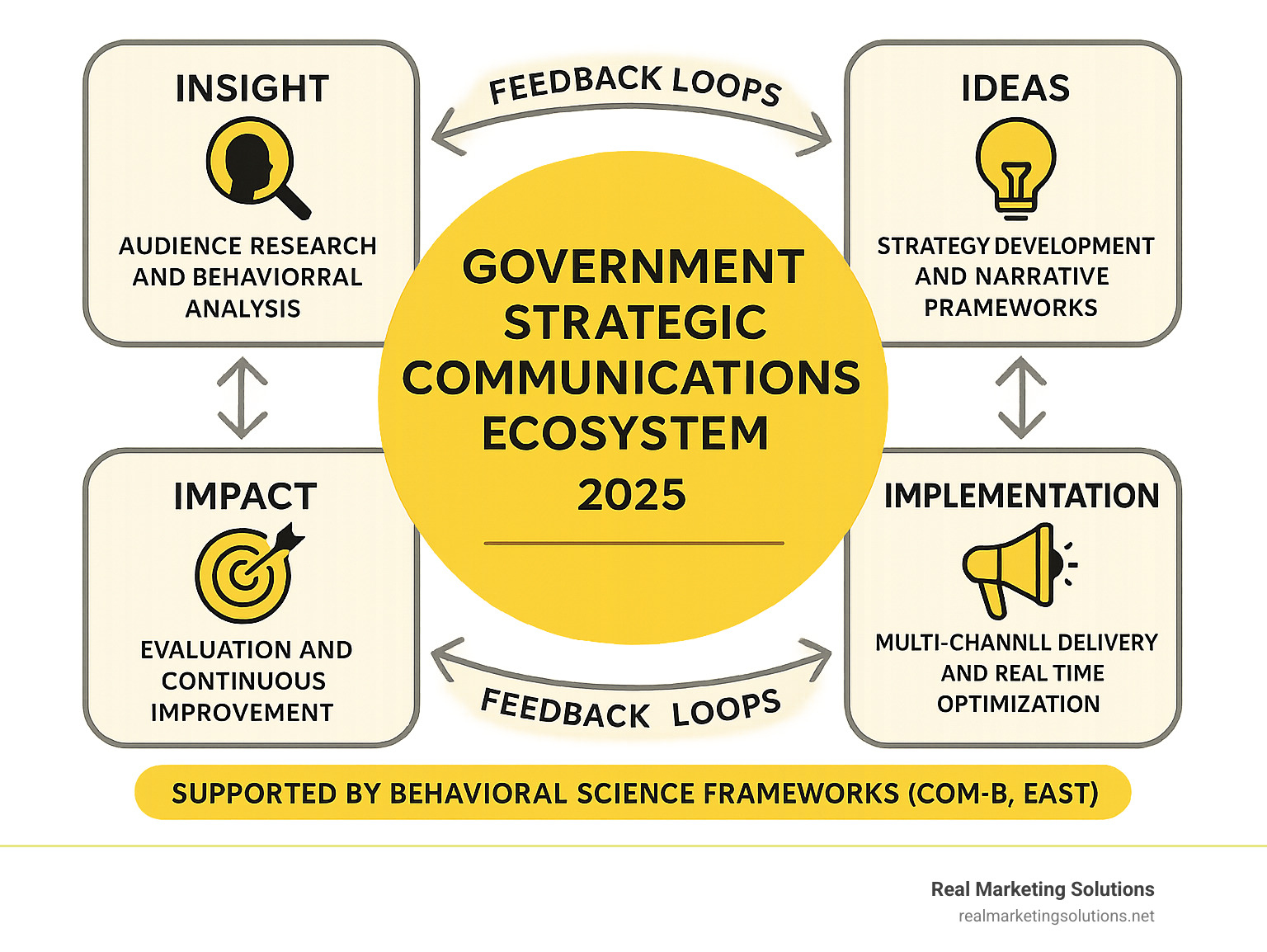
The OASIS Framework serves as the UK’s gold standard for campaign planning: Objectives tied to policy outcomes, Audience insights through research, behavioral Strategy, coordinated Implementation, and Scoring methods to measure success. OASIS forces you to answer the hard questions before creating content.
The COM-B Model reveals that every action requires three elements: Capability (skills and knowledge), Opportunity (environmental support), and Motivation (desire to change). Without all three pieces, communication campaigns fall flat.
The EAST Framework translates behavioral insights into practical message design. Effective interventions make desired actions Easy by removing friction, Attractive through personal relevance, Social by leveraging peer influence, and Timely by reaching people when they’re most receptive.
For international efforts, the PITCH Model emphasizes building Partners & allies, developing audience Insight, mobilizing Trusted voices, creating Compelling content, and maintaining Honesty & integrity.
The MCOM Functions framework structures team capabilities around Insight development, Ideas generation, Implementation coordination, and Impact evaluation.
Successful campaigns blend elements from multiple frameworks rather than rigidly following just one.
Embedding Behavioural Science in Government Strategic Communications
The integration of behavioral science transforms government strategic communications from information broadcasting into genuine behavior change. The shift happened when researchers realized that 90% of human actions stem from instinctive and emotional responses, not rational analysis.
The COM-B model helps diagnose resistance to new policies. Take childhood obesity prevention: Capability barriers might include parents lacking cooking skills. Opportunity barriers could involve living in food deserts. Motivation barriers might stem from cultural norms or competing priorities.
Once you identify real barriers, you can design targeted interventions. The SALT framework provides tactical guidance: Simplify language and calls to action, Amplify through trusted messengers, Localise messages for specific communities, and Target audiences based on behavioral drivers.
The UK’s COVID-19 response showcases this approach. The “Hands, Face, Space” messaging reached 95% of UK adults, with seven out of eight people understanding key behaviors. The NHS COVID-19 app achieved over 21 million downloads.
What made it work? Messages were Easy to remember, Attractive because they offered clear protection, Social through widespread adoption, and Timely during peak concern.
This behavioral approach doesn’t manipulate people – it removes unnecessary friction and aligns communication with how humans naturally process information.
Crafting a Winning Strategy
Building effective government strategic communications strategy starts with setting the right objectives. The C-SMART framework helps create objectives that drive results: challenging enough to push boundaries, specific about desired behaviors, measurable with clear metrics, achievable given resources, relevant to policy goals, and timely with firm deadlines.
Audience mapping goes deeper than demographics. Successful campaigns understand what motivates audiences to act. What keeps them up at night? Where do they turn for reliable information? Who do they trust when making decisions?
Smart segmentation considers behavioral determinants, information preferences, trust networks, and barriers to action. Understanding these factors helps identify the right messengers and reveals what’s stopping people from taking desired actions.
The UK government’s National Data Strategy recognizes that good data drives good decisions. When communicators base strategies on evidence rather than hunches, campaigns perform dramatically better.
Channel selection requires balancing reach with influence. Traditional media might reach millions, but social media enables targeted conversations with specific audiences. Direct engagement builds deeper relationships, though it requires more resources per person reached.
Effective campaigns weave multiple channels together like instruments in an orchestra. The Brexit Transition Period campaign generated 63 million website visits while using targeted advertising, media relations, and a custom Checker Tool used over 5 million times.
From Insight to Action: The Government Strategic Communications Playbook
Turning insights into compelling government strategic communications requires building narratives that move people to action. Strong government stories follow a clear path: define the problem in terms your audience cares about, explain your solution in plain language, provide proof points that build credibility, make your call to action crystal clear, and paint a picture of how taking action improves their lives.
Credibility comes from alignment between what you say and what you do. The fastest way to destroy trust is creating gaps between promises and reality. Government communicators must work with policy teams to ensure every message reflects actual capabilities.
Timing and cadence can make or break campaigns. External partners typically need at least 10 days notice for events, while coordinated announcements across departments often require two weeks for approvals.
Sophisticated campaigns use a three-horizon approach: Horizon 1 covers the next six months with immediate responses, Horizon 2 spans 6-18 months with strategic campaigns tied to policy rollouts, and Horizon 3 looks beyond 18 months to build long-term narratives supporting future initiatives.
Execution in Action: Crisis, Digital & Engagement
When pressure is on, government strategic communications reveals its true value. Crisis situations demand immediate, coordinated responses that can literally save lives.
The CDC’s COVID-19 response offers a masterclass in crisis communication. Facing a pandemic with rapidly evolving science, the CDC used social media analytics to track public sentiment in real time, understanding how fear and misinformation were spreading so they could respond with clarity and facts.
The key breakthrough was maintaining regular communication even without new information. When official sources go quiet, rumors rush in to fill the void. By providing consistent updates and acknowledging uncertainty honestly, the CDC prevented misinformation from taking root.
The UK’s “Get Ready for Brexit” campaign demonstrates strategic coordination at scale: 99% of UK adults were reached, with 73% remembering key messages and 52% taking action. Success came from laser focus on specific behaviors – telling businesses exactly which forms to complete and giving citizens clear preparation steps.
Singapore’s Smart Nation initiative shows how government strategic communications can drive digital change. Achieving 99% adoption of digital government services required helping elderly citizens learn new systems, addressing privacy concerns, and making digital services genuinely easier than paper processes.
The RESIST 2 framework gives communicators systematic ways to fight misinformation: recognize emerging false narratives, provide early warnings to stakeholders, maintain situational awareness, assess potential impact, and deploy both strategic and tactical responses.
Sometimes amplifying accurate information from trusted sources works better than explicitly debunking false claims. The goal is ensuring citizens have reliable information when making decisions.
Two-Way Dialogue & Citizen Feedback Loops
Modern government strategic communications has moved beyond officials speaking and citizens listening. Today’s citizens expect real conversations – opportunities to ask questions, share concerns, and influence decisions.
Digital tools make genuine dialogue possible at scale. Chatbots handle routine questions 24/7, freeing human staff for complex issues. Online surveys gather feedback quickly, while participatory platforms let citizens contribute ideas and set priorities.
Successful engagement combines digital convenience with human connection. Town halls create space for real-time questions and answers. There’s something powerful about hearing directly from decision-makers.
Open data initiatives demonstrate transparency while giving citizens tools to independently analyze government performance. Instead of asking people to trust you, you’re inviting them to verify your work.
The critical factor is making feedback actually matter. Citizens quickly spot “consultation theater” – exercises that ask for input without intention to act on it. When people share thoughts, they deserve to know how their input influenced decisions.
Measuring Impact & Continuous Improvement
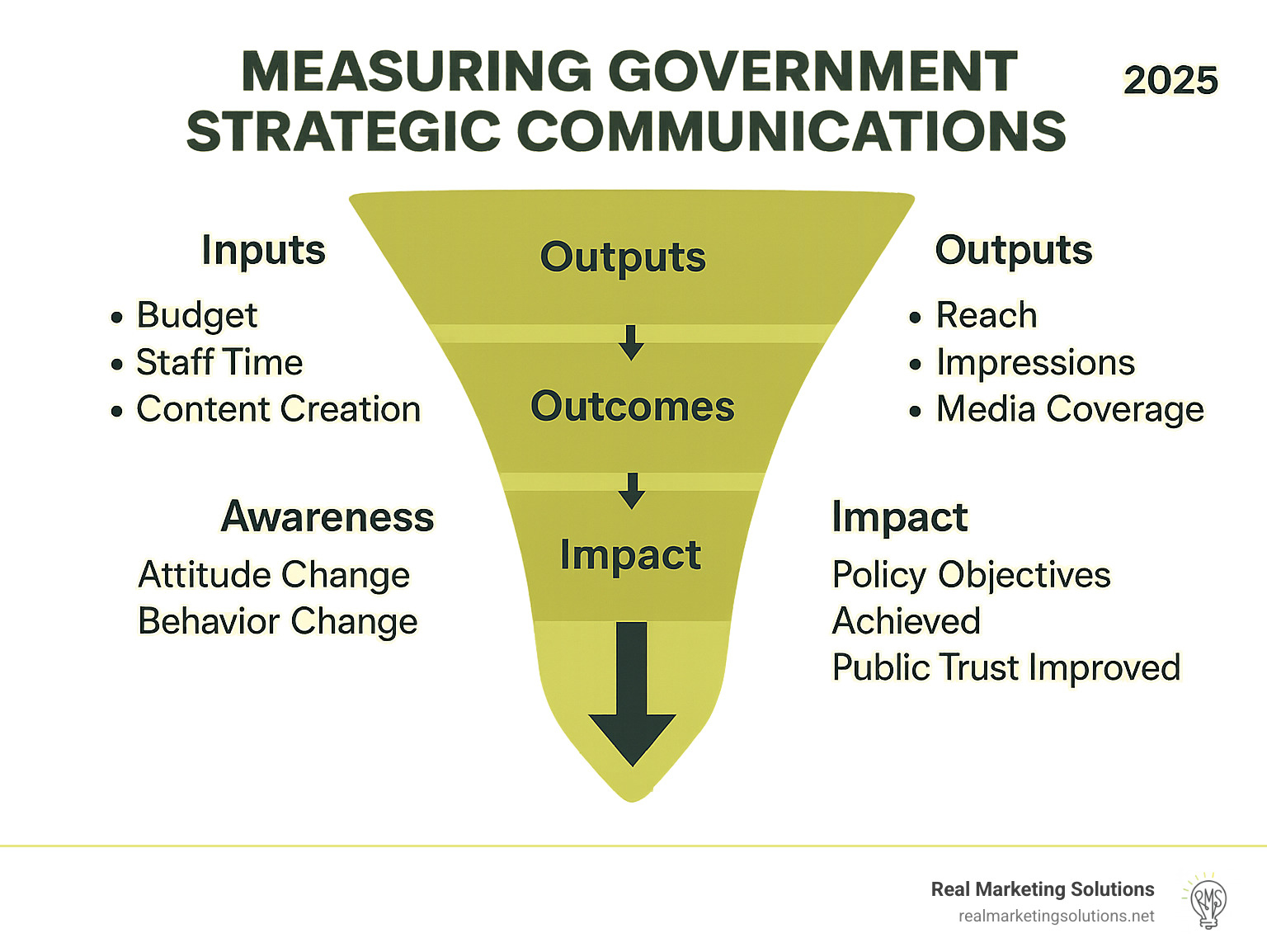
The real test of government strategic communications isn’t how many people saw your message – it’s whether they actually did something about it. The Government Communication Service’s Evaluation Framework 2.0 focuses on outcomes over outputs.
You could have millions of social media impressions, but if nobody changes behavior, did your campaign work? Smart government communicators measure what matters most – the actions people take, not just eyeballs captured.
Setting baselines is essential. Before launching campaigns, know where you’re starting from. What do people currently know? How do they feel about proposed changes? What actions are they taking? How much do they trust your organization?
Key Performance Indicators should connect directly to policy goals. For public health campaigns, track vaccination rates or screening participation. Website visits are nice to know, but they don’t tell you if people are getting healthier.
Modern digital campaigns allow optimization while running. A/B testing compares different approaches with similar audience groups. The UK’s COVID-19 campaign tested everything from color schemes to button text, constantly improving performance.
Real-time dashboards combine hard numbers like reach and conversions with softer insights like sentiment analysis. When something isn’t working, you can spot it quickly and make adjustments.
Post-campaign evaluation captures crucial lessons. Which messages resonated? How did different segments respond? What surprised you? These insights become gold for future campaigns.
Scaling What Works Across Government
When government communications campaigns succeed, that knowledge shouldn’t stay locked in one department. The UK’s Government Communication Service maintains a central repository where teams access evaluation reports, case studies, and proven strategies.
Training programs ensure everyone speaks the same language about strategic communications. Effective programs mix theory with hands-on practice using relatable case studies.
Innovation funds give teams permission to experiment without risking entire budgets on unproven approaches. Small pilots test new technologies before full-scale implementation.
Agile iteration cycles keep campaigns flexible and responsive. Instead of waiting months to see results, teams make real-time adjustments based on performance data and feedback.
The goal isn’t perfection from day one – it’s continuous improvement over time, creating cycles of learning that make government communications more effective and trusted.
Frequently Asked Questions about Government Strategic Communications
How is strategic communication different from public affairs or reactive PR?
Government strategic communications is like playing chess – thinking several moves ahead and considering how each action affects long-term goals. Public affairs and reactive PR are more like checkers – responding to what’s happening right now.
Strategic communication starts with the end goal in mind. For increasing vaccination rates, strategic communicators ask: Who needs vaccination? What’s stopping them? What would motivate action? Then they work backward to design messages, choose channels, and time campaigns for specific outcomes.
Public affairs teams focus on media relations and stakeholder management – building journalist relationships, responding to press inquiries, managing external partnerships. While supporting strategic goals, these activities are often more reactive.
The biggest difference is timing and integration. Strategic communicators get involved during policy development, not after decisions are made. They help shape policies by considering public response and potential communication challenges.
Which frameworks should a small agency start with first?
Start with the OASIS framework for campaign planning. It provides solid structure without requiring advanced psychology knowledge. OASIS helps you think through basics: What are you trying to achieve? Who needs to change behavior? How will you reach them? What will you say? How will you know if it worked?
Next, add the COM-B model to understand why people aren’t already doing what you want. Most communication failures happen because agencies assume people just need more information. In reality, people might lack capability (skills), opportunity (resources), or motivation (desire) to act.
The EAST framework gives practical guidance for better messaging immediately. Make desired actions Easy by removing barriers, Attractive by connecting to what people care about, Social by showing others are acting, and Timely by delivering messages when people are ready.
How do you measure behavioural change outcomes in practice?
Measuring behavior change is where many government strategic communications efforts fall short. It’s tempting to count likes and website visits because they’re easy to track, but those don’t show whether anyone changed behavior.
Start with baseline measurements before campaign launch. For voter registration campaigns, find current registration rates in target communities. Without baselines, you can’t prove communication made any difference.
Use administrative data whenever possible because it shows what people actually did, not what they say they did. Program enrollment numbers, permit applications, and service usage provide objective evidence of behavior change.
Combine different data types for complete pictures. Surveys capture attitudes and self-reported behaviors, while web analytics show paths from awareness to action. Set up systems to capture both immediate actions and long-term outcomes.
Meaningful behavior change often takes time to appear in data. Some successful campaigns show biggest impact months after launch as word spreads and social norms shift.
Next Steps
Government strategic communications has transformed from simply sharing information to sophisticated campaigns that change behavior and drive policy success. The secret? Combining deep audience understanding with behavioral science and rigorous measurement.
When government communications work well, amazing things happen. Singapore got 99% of citizens using digital services. The UK reached nearly every adult with Brexit guidance. The VA doubled public trust through strategic engagement. These weren’t accidents – they were results of strategic thinking that put audience needs first.
The foundation remains the trust triangle – authenticity, logic, and empathy working together. But tools have gotten sophisticated. Frameworks like OASIS structure campaigns from start to finish. COM-B reveals why people resist change. EAST makes messages impossible to ignore.
The old days of “spray and pray” communications are over. Citizens expect transparency, speed, and genuine dialogue. They spot inauthentic messaging easily and want to be heard, not just talked at.
Government agencies that master strategic communications will build stronger public trust, achieve better policy outcomes, and create institutions that can weather any storm. Those that don’t will find themselves shouting into an increasingly skeptical void.
At Real Marketing Solutions, we’ve seen how challenging it can be for government agencies to cut through the noise and genuinely connect with their communities. The digital landscape changes daily. Audience expectations keep rising. Budgets remain tight while demands for results grow stronger.
Our team brings the same strategic thinking and behavioral insights outlined in this guide to support agency initiatives across the United States. We understand that government communications isn’t just about marketing – it’s about serving the public good through effective engagement.
Whether you’re rolling out new policy, managing crisis, or building long-term community relationships, we provide strategic depth and tactical expertise needed to achieve real impact. Our experience with data-driven approaches, proven frameworks, and multi-channel execution ensures your communications investment delivers measurable results for the communities you serve.
Because effective government strategic communications isn’t about clever messaging or flashy campaigns. It’s about building the trust and understanding that makes democracy work. Book your complimentary consultation and start building trust today.
Subscribe to the Social Scoop
Receive regular news & updates in the world of social media marketing.
COMPANY ACCOLADES


Follow Us


