


Why Search Performance Matters More Than Ever
Photo credit: Tobias Dziuba
Improve search performance is the key to open uping better visibility, higher traffic, and more conversions for your business. Whether you’re talking about how your website ranks on Google or how quickly users can find what they need on your site, search performance directly impacts your bottom line.
Quick ways to improve search performance:
- Optimize your content – Use relevant keywords naturally and update content regularly
- Fix technical issues – Improve page speed, mobile responsiveness, and site structure
- Build authority – Earn quality backlinks from reputable websites
- Improve user experience – Make your on-site search fast and accurate
- Monitor and measure – Use official search engine tools to track progress
Search performance has two main parts that work together. SEO (Search Engine Optimization) helps your website show up when people search on Google, Bing, or other search engines. On-site search helps visitors find specific information once they’re already on your website.
Both are crucial for business success. Poor search performance means potential customers can’t find you online or get frustrated trying to steer your site. Good search performance means more qualified leads finding your services and staying engaged with your content.
The businesses we work with – from mortgage companies doing $300k+ annually to government agencies – all share one challenge: they need expert-level search optimization without the overhead of building an in-house team.
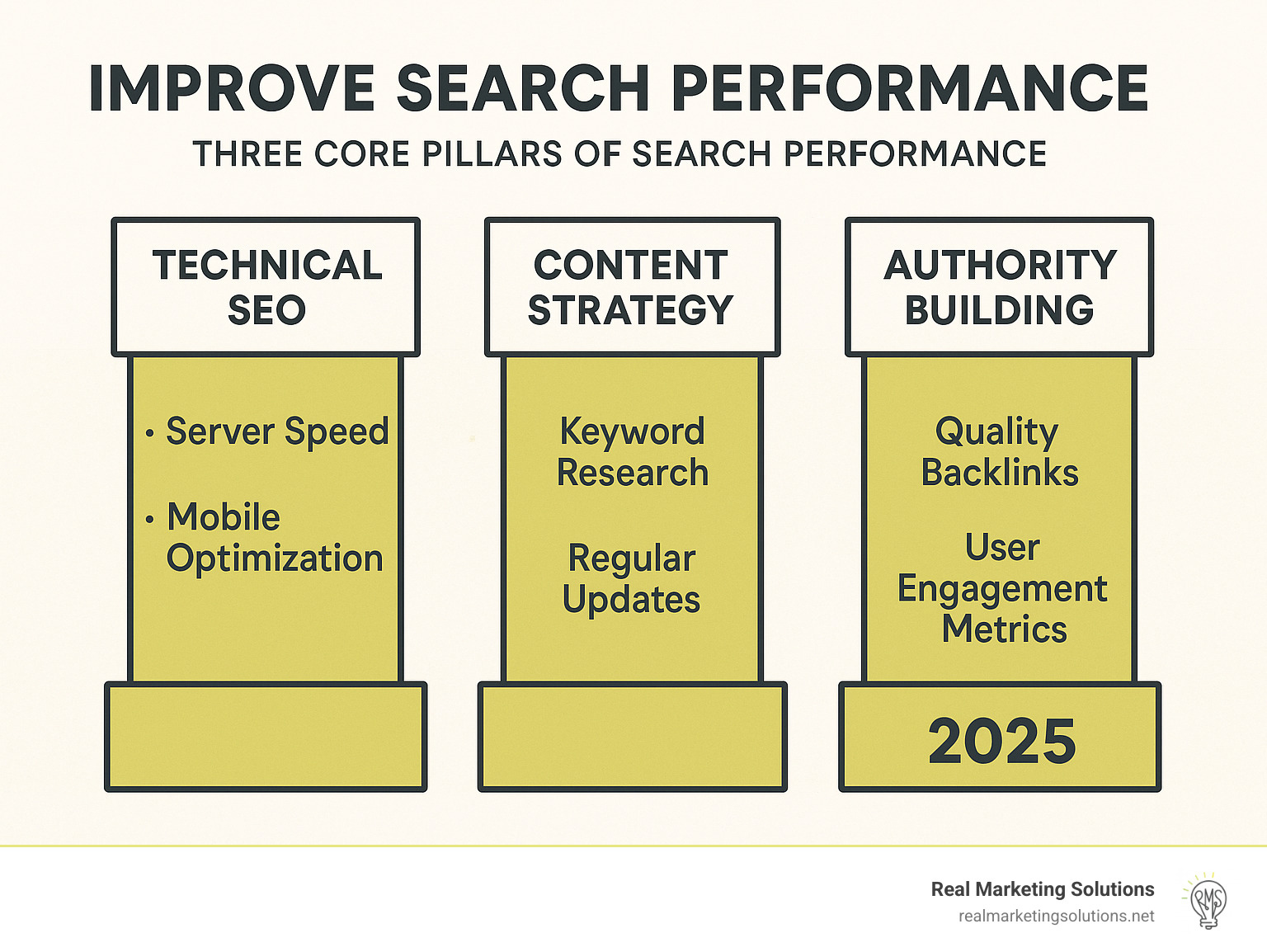
This guide breaks down the proven strategies that drive real results. You’ll learn how search engines actually work, what technical factors matter most, and how to create content that both search engines and humans love.
How to Master the SEO Fundamentals of Search Performance
Search engines like Google use automated programs called crawlers to explore the internet, finding and indexing pages for their digital library. This crawling and indexing process is how your website gets found.
But getting indexed isn’t enough; you want to rank highly. Ranking factors are the criteria search engines use to find helpful, relevant, and trustworthy content.
This brings us to E-E-A-T: Experience, Expertise, Authoritativeness, and Trustworthiness. It’s not a direct ranking signal, but it’s Google’s way of saying “show us you know what you’re talking about.” When you’re writing about mortgage rates or real estate trends, your years of industry experience should shine through every piece of content.
- Understanding user search behavior is like being a mind reader – but with data. Your customers go through different stages when they search. Someone typing “what is a mortgage” is in the awareness stage, just starting their journey. But someone searching “best mortgage rates in Denver” is ready to take action.
- Search intent mapping helps us match your content to what people actually want to find. This strategic approach ensures your website answers the right questions at the right time, which can dramatically improve search performance.
For a deeper dive into tracking these efforts, check out our guide on Digital Marketing Analytics: A Beginner’s Guide.
Understanding Your Audience and Keywords
Keywords are simply the words your customers type into search boxes when they’re looking for what you offer. The magic happens when we match those search terms with your website content in a way that feels natural and helpful.
Gone are the days of stuffing keywords into every sentence like a Thanksgiving turkey. Modern search engines are smart enough to spot this outdated trick and will actually penalize your site for it. Instead, we focus on strategic, natural keyword placement that serves both search engines and real humans.
Customer search stages play a huge role in keyword strategy. Early-stage searchers might use broad terms like “home buying process,” while those ready to act search for specific phrases like “mortgage pre-approval requirements.” Understanding these stages helps us target the right keywords for each piece of content.
The sweet spot for keyword research lies in finding terms that your audience actually uses. If you’re a real estate agent in Napa Valley, “Napa Valley homes for sale” will serve you much better than generic terms like “houses.”
Long-tail keywords – those longer, more specific phrases – are often your best friends. They typically have less competition and attract people who know exactly what they want. Someone searching for “FHA loan requirements for first-time buyers in California” is probably ready to have a serious conversation.
Keyword placement should feel effortless. Work your target phrases naturally into your page URLs, titles, and headings. A page about engineering management degrees should ideally include those terms in its web address, page title, and header tags (H1, H2, H3). This helps search engines understand your content’s focus.
For more practical tips on effective keyword use, explore our SEO Tips.
Creating High-Quality, Authoritative Content
Here’s the truth that never gets old: content is the number one ranking driver. Search engines exist to help people find the best possible answers to their questions, and your content should deliver exactly that.
Quality content isn’t about fancy words or complex concepts. It’s about creating unique, helpful, and reliable information based on your real knowledge and experience. In the mortgage industry, for instance, a detailed guide explaining different loan types will always outperform generic blog posts that could apply to any business.
Our Content Strategy focuses on creating compelling and useful content that genuinely helps your audience while establishing your expertise. We believe in authenticity – content built on real experience stands out, especially in a world where AI-generated content is everywhere.
- Regular content updates are like giving your website a pulse. Fresh content encourages search engines to visit your site more often, helping them find and index new information faster. This could mean adding new case studies, updating industry statistics, or sharing recent success stories.
- Content freshness signals to search engines that your site is an active, valuable resource rather than a dusty digital brochure. We recommend reviewing and refreshing your content at least every six months, removing outdated information and adding new insights that reflect current market conditions.
This commitment to quality and freshness can significantly improve search performance while building trust with your audience. For more insights into effective content marketing strategies, visit More on content marketing.
How Do On-Page and Technical SEO Improve Organic Search Performance?
Think of improving search performance like building a house – you need both a solid foundation and beautiful rooms that people actually want to visit. That’s exactly what on-page and technical SEO do for your website.
- On-page SEO focuses on optimizing individual web pages to rank higher and earn more relevant traffic. This includes everything visitors can see and interact with – your content, headings, and page elements.
- Off-page SEO happens outside your website, primarily through backlinks from other reputable sites that vouch for your credibility.
At Real Marketing Solutions, we’ve learned that both elements work hand-in-hand. You can have the most engaging content in the world, but if your site takes forever to load or doesn’t work on mobile devices, you’re fighting an uphill battle.
Your site structure acts like a roadmap for both visitors and search engines. When we organize your pages with clear, descriptive URLs like /mortgage-services/first-time-buyers.html instead of random character strings, everyone wins. Search engines understand your content better, and visitors know exactly where they are on your site.
Here’s something that might surprise you: mobile-first indexing means Google primarily looks at the mobile version of your content when deciding how to rank your site. This isn’t just about being mobile-friendly anymore – it’s about mobile excellence. Your website needs to be responsive and lightning-fast on smartphones and tablets.
Page speed and Core Web Vitals have become crucial ranking factors because they directly impact user experience. These metrics measure how quickly your content loads, how fast users can interact with your page, and whether elements shift around unexpectedly while loading. When we optimize these technical elements for our clients in mortgage, finance, and real estate, we often see immediate improvements in both search rankings and user engagement.

How to Improve Search Performance with On-Page Elements
- Meta tags are like the preview snippets that help search engines and users understand what each page is about. Your title tag is the most important piece – it’s the clickable headline people see in search results. We craft titles that are clear, compelling, and include your most important keywords naturally.
- Meta descriptions don’t directly boost your rankings, but they’re your elevator pitch to potential visitors. A well-written meta description can be the difference between someone clicking on your result or scrolling past to a competitor.
- Header tags (H1, H2, H3) do double duty by organizing your content for readers while signaling to search engines what’s most important on your page. We structure these headings to create a logical flow that guides visitors through your content while naturally incorporating relevant keywords.
- Image optimization goes far beyond just making pictures look good. Every image needs descriptive alt text that explains what the image shows and how it relates to your content. This helps search engines understand your images and makes your site accessible to visitors using screen readers.
- Structured data markup using sites like Schema.org can make your search listings stand out with rich snippets – think star ratings for reviews or specific details about your services. These improved listings often attract more clicks and can significantly improve search performance.
- Internal linking creates pathways through your site that help visitors find more relevant content while distributing authority across your pages. When we link to related mortgage products or real estate services within your content, we’re helping both users and search engines understand the connections between your offerings.
For practical tips you can implement today, check out our SEO Hacks for Your Business.
Off-Page Signals: How to Build Authority
Backlinks are essentially recommendations from other websites, and search engines treat them like votes of confidence in your content. When a reputable financial blog links to your mortgage guide, it signals that your content is trustworthy and valuable.
The key to earning quality backlinks lies in creating content that others genuinely want to reference. Our content specialists focus on developing resources that become go-to references in your industry – comprehensive guides, original research, or insightful analysis that others naturally want to share.
Natural link building happens when you consistently publish valuable content.
- Guest blogging on industry publications can earn you quality links while showcasing your expertise.
- Broken link building involves finding broken links on other sites and suggesting your content as a helpful replacement.
- Resource page outreach gets your content listed on curated industry resource pages, while partnerships and collaborations with other businesses can create mutual linking opportunities.
Duplicate content can seriously hurt your authority because it confuses search engines about which version to show in results. We implement canonicalization strategies using 301 redirects or the rel="canonical" tag to ensure search engines know which version of your content is the authoritative one.
This technical approach to managing duplicate content ensures that all your link equity flows to the right pages, helping to improve search performance across your entire site. When everything works together – quality content, clean technical implementation, and natural authority building – your search performance can improve dramatically.
Tuning Your Site Search for Direct Answers and Speed
Think about the last time you visited a website and couldn’t find what you were looking for through their search function. Frustrating, right? That’s exactly why we put so much emphasis on improving search performance for the internal search capabilities of our clients’ websites.
Your on-site search is like having a helpful store clerk who knows exactly where everything is located. When it works well, users find what they need quickly and stay engaged with your content. When it doesn’t, they leave for your competitors’ sites.
At Real Marketing Solutions, we’ve learned that user experience signals are becoming increasingly important ranking factors for search engines. Google pays attention to how people interact with your site, including how effectively they can steer and find information. A smooth, fast on-site search experience keeps visitors engaged longer and reduces bounce rates.
The foundation of great on-site search revolves around three key areas:
- Index Composition: How your data is organized
- Query Design: How search requests are structured
- Service Capacity: The resources available to handle searches
Think of it like organizing a library – the better your system, the faster people find their books.
Modern search platforms offer powerful features that can dramatically improve search performance. Asynchronous search allows heavy queries to run in the background without slowing down your site, while concurrent segment search processes different parts of your data simultaneously for faster results.
Want to see how our expertise translates into real-world results? Explore our Case Study: Improving On-Site Search with Real Marketing Solutions’ Expertise.
Key Principles to Improve Search Performance on Your Website
Making your on-site search lightning fast isn’t magic – it’s about following proven principles that we’ve refined through years of working with mortgage companies, real estate firms, and government agencies.
Limiting data retrieval is your first line of defense against slow searches. We always tell our clients: the less data your search engine has to dig through, the faster it responds. This means being smart about time windows – if someone’s searching for recent mortgage rates, there’s no need to scan historical data from five years ago. We also encourage using specific search terms rather than broad wildcards that force the system to examine everything.
Document modeling might sound technical, but it’s really about organizing your information logically. We structure data to avoid complex operations that can slow searches by hundreds of times. Instead of making your search engine work overtime to connect related information, we organize it efficiently from the start.
The role of filesystem cache is crucial but often overlooked. We ensure that frequently accessed parts of your search index stay in your server’s memory, dramatically speeding up common searches. It’s like keeping your most-used tools within arm’s reach instead of buried in the garage.
Avoiding wildcards in search queries is another key strategy. While they seem convenient, wildcard searches can bring your site to a crawl because they force the system to examine every possible match. We help design search interfaces that guide users toward more efficient search patterns.
Our team also focuses on document modeling strategies that pre-organize information for faster retrieval. Rather than forcing your search engine to calculate results on the fly, we structure data so common searches return results almost instantly.
Common Bottlenecks and How to Address Them
Even with the best planning, search bottlenecks can emerge. The good news? We’ve seen them all and know exactly how to fix them.
Hardware resource limits are often the culprit behind sluggish search performance. When your server’s CPU is constantly maxed out or there’s not enough memory to handle search requests efficiently, users notice immediately. Our team evaluates your infrastructure and recommends optimal solutions, whether that’s upgrading to faster SSD drives or ensuring adequate RAM for smooth operations.
Handling partial term searches requires special attention because they’re computationally expensive. When users type partial words or use fuzzy matching, the system has to work much harder. We design search interfaces that balance user convenience with performance, guiding users toward search patterns that deliver fast, accurate results.
Managing complex queries is where our expertise really shines. Simple keyword searches are fast, but as queries become more complex, performance can degrade quickly. We optimize these by restructuring how searches are processed and by using more efficient alternatives to resource-intensive operations.
| Query Type | Performance Impact | Example |
|---|---|---|
| Simple Keyword Search | Fast | product: "laptop" |
| Partial Term (Prefix/Fuzzy) | Moderate to Slow | product: "lap*" or product: "laptap~" |
| Wildcard (leading) | Very Slow | product: "*top" |
| Regex Query | Very Slow | product: /l.p[a-z]+p/ |
NOT Expression | Slower than AND | NOT status=200 |
search.in function | Fast for many values | status.in(["200", "301", "404"]) |
Avoiding performance issues with regular expressions is critical because they can be incredibly powerful but notoriously slow on large datasets. We carefully evaluate when regex is truly necessary and work to simplify complex patterns that could bog down your search.
Optimizing read-only indices is particularly valuable for businesses with historical data, like mortgage companies with years of loan records. For data that’s no longer being updated, we can restructure it for maximum search efficiency.
The beauty of working with our team is that we handle all these technical details behind the scenes. You get a search function that improves search performance across your entire site, while we manage the complex optimization work that makes it all possible. Your users get the fast, relevant results they expect, and you get the engagement and conversions that drive your business forward.
Measuring, Monitoring, and Maintaining Your SEO Success
SEO is a marathon, not a sprint. Setting realistic expectations is crucial for long-term success, as results don’t happen overnight. You won’t magically rank #1 for your dream keywords.
SEO takes time to show results. Typically, you’ll start seeing increased impressions (how often your site appears in search results) within 4-6 months of implementing changes. Those impressions gradually translate into more clicks over the following months. Our team across California and the USA has seen this pattern countless times with mortgage companies, real estate firms, and government agencies we work with.
The first step in measuring success is making sure search engines can actually find your content. A simple way to check this is using the site: search operator – just type site:yourwebsite.com into a search engine. If your pages show up, you’re indexed. But there’s more to it than that.
Search engines need to see your page exactly the way your visitors do. This means having access to all your CSS files, JavaScript, and other resources that make your page function properly. We use the URL inspection tools provided by search engines to verify this regularly for our clients.
Sometimes you might want to keep certain pages out of search results entirely. Password protecting pages or using a noindex meta tag are effective ways to do this. We help our clients determine which pages should be public and which should stay private.
Measuring success goes far beyond just checking your rankings. We track impressions, clicks, click-through rates, and how these metrics change over time. The goal isn’t just to improve search performance – it’s to drive real business results. For a deeper dive into our measurement approach, check out our guide on How to Measure Success with Marketing Analytics.

Essential Tools and Long-Term Strategy
The right tools make all the difference when you’re trying to maintain and improve search performance over time. We’ve found that combining the right technology with a solid long-term strategy creates lasting results.
- Official search engine webmaster tools are essential for SEO monitoring. These free platforms show you exactly how your site performs in search. We use them to see which queries bring people to your site, identify pages that aren’t getting indexed, submit sitemaps, and spot technical issues before they hurt your rankings. This ensures visibility across all major search engines, reaching your audience wherever they search.
- Regular site audits are like health checkups for your website. We conduct these for our clients to identify technical SEO problems, content gaps, and new opportunities. These audits often reveal quick wins that can boost performance relatively fast.
- Understanding your competition provides valuable insights without copying what they do. We analyze competitors’ content strategies, backlink profiles, and keyword targeting to find gaps in the market and new angles for our clients’ content.
- Staying current with SEO trends is perhaps the most challenging part of long-term SEO success. Search engine algorithms change constantly. Voice search, AI-assisted search, and mobile-first indexing have all reshaped how we approach optimization. Our team monitors industry developments and algorithm updates daily, so our clients don’t have to worry about falling behind.
The key to long-term success is treating SEO as an ongoing investment, not a one-time project. We work with clients to develop sustainable strategies that grow their organic visibility month after month. Our approach to Digital Marketing Strategy emphasizes this continuous improvement mindset, ensuring your website stays competitive and visible for years to come.
Every business is different. A mortgage company in California will have different SEO needs than a government agency in Oregon. That’s why we customize our monitoring and maintenance strategies to fit each client’s unique goals and industry requirements.
Partnering for Peak Search Performance
After diving deep into search optimization, one thing becomes crystal clear: successfully learning how to improve search performance isn’t just about checking boxes or following a simple formula. It’s about creating a harmonious blend of strategy, technical expertise, and genuine understanding of your audience’s needs.
Think of it this way – content truly is king, but even the best king needs a strong foundation to rule effectively. Your high-quality, relevant content must answer real questions your customers are asking. It needs to be fresh, engaging, and demonstrate your expertise in ways that both search engines and real people can appreciate. Whether you’re explaining mortgage rates or helping someone find their dream home, authenticity and value always win.
But here’s where many businesses stumble: they focus so much on creating great content that they forget about the technical foundation holding it all up. Technical health is absolutely crucial for success. Your site needs to load quickly, work perfectly on mobile devices, and be structured in a way that search engines can easily understand and index. Your on-site search needs to help visitors find exactly what they’re looking for without frustration.
The magic happens when you realize that user experience ties everything together. Search engines have gotten incredibly sophisticated at recognizing what makes users happy. Fast loading times, intuitive navigation, relevant search results, and content that genuinely helps – these aren’t just nice-to-haves anymore. They’re essential ingredients for long-term success.
At Real Marketing Solutions, we’ve seen how these elements work together to create remarkable results. Our team brings together specialists in SEO, content creation, technical optimization, and user experience design. We understand the unique challenges facing businesses in mortgage, finance, and real estate, where trust and expertise matter more than ever.
What sets us apart is our commitment to delivering measurable results through personalized strategies. We don’t believe in one-size-fits-all solutions because every business has its own story, challenges, and goals. Whether you’re a small business looking to expand your digital footprint or a government agency working to improve public engagement, we have the deep strategy and diverse expertise to help you succeed.
The journey to peak search performance isn’t always quick or easy, but with the right partner, it becomes much more manageable. We’re here to handle the complexities while you focus on what you do best – serving your customers and growing your business.
Ready to see what’s possible when strategy meets execution? Find our comprehensive marketing services and let’s start building something amazing together. Your future customers are out there searching – let’s make sure they find you.
Subscribe to the Social Scoop
Receive regular news & updates in the world of social media marketing.
COMPANY ACCOLADES


Follow Us


